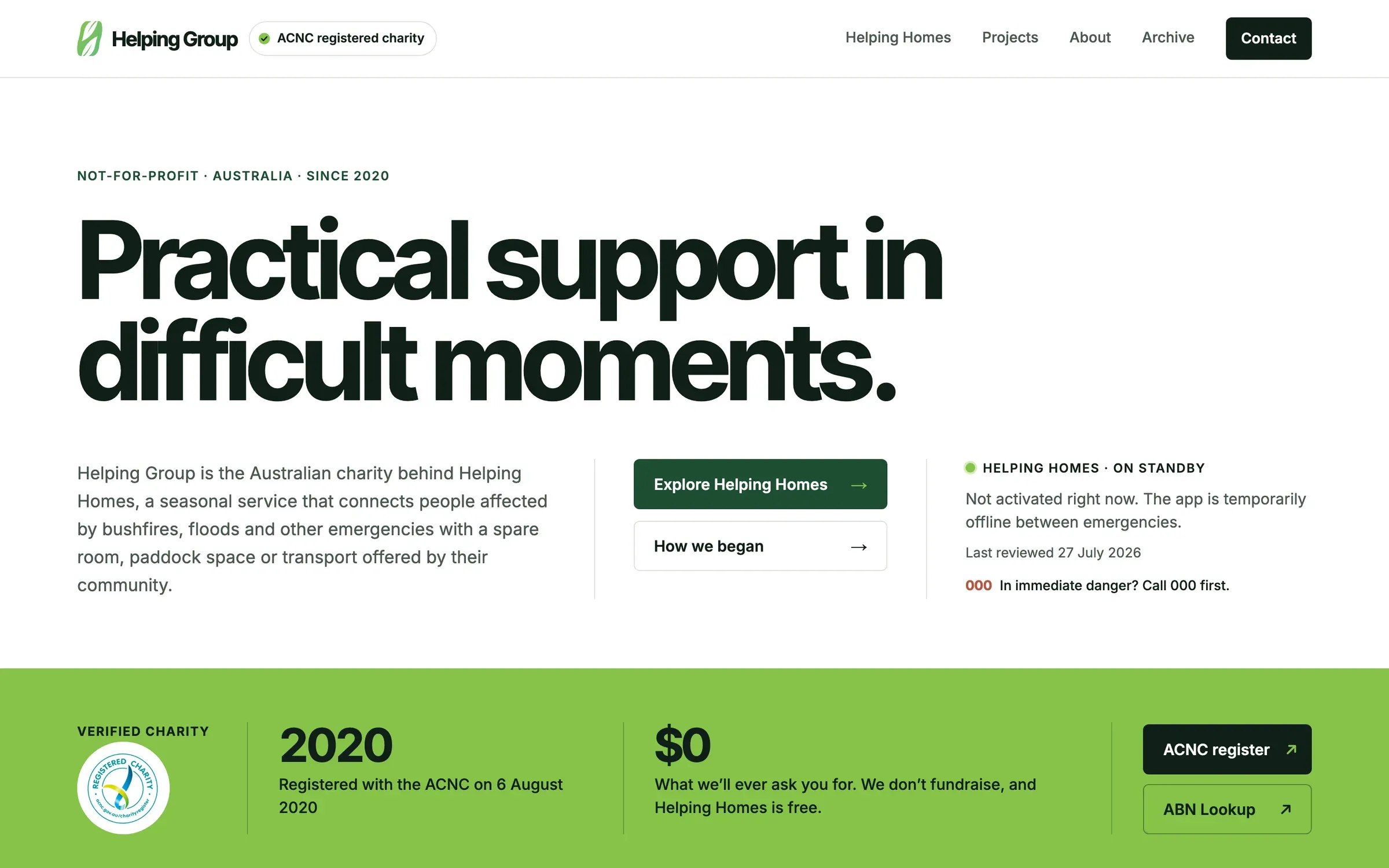
It started with somewhere safe to sleep
Helping Group began during Australia’s Black Summer bushfires. People were evacuating with little notice while thousands of other Australians were offering spare rooms, holiday homes, caravans, paddocks, and places for animals. The goodwill was obvious; the connection between an offer and a person who needed it was not.
I built the first version of Helping Homes as a direct response. It was deliberately small—one PHP file and roughly 440 lines—because the useful deadline was measured in hours, not product quarters. People could publish an offer of emergency accommodation and those leaving a fire-affected area could find somewhere nearby.
Within the first week, more than 5,000 beds had been registered nationwide and the site was receiving tens of thousands of visits a day. It was covered by Australian and international media, but the clearest signal was much simpler: strangers were opening their homes to strangers.
From one service to an organisation
Helping Homes proved that a focused digital tool could organise community capacity that already existed. It also revealed that the same pattern appeared beyond emergency accommodation: people wanted to help, but often lacked a practical way to act.
Helping Group grew around that observation. By the following year it had become a not-for-profit organisation with more than 20 members working across a portfolio of community initiatives, including:
- Helping Homes, connecting people and livestock affected by natural disasters with emergency accommodation and agistment.
- Our Move, helping communities prepare for future fire seasons.
- Support Them, making it easier to discover and support local businesses.
- What’s My Impact?, helping people understand how investments align with their values.
- Rainbow Restoration, using collectible stories to make LGBTQIA+ history more visible.
The initiatives were different, but the method was consistent: identify a moment where good intent was getting stuck, then build the smallest useful bridge between people.
My role
I founded Helping Group and led the early product, engineering, media, partnership, and organisational work. That meant moving constantly between code and coordination: shipping features, speaking with people affected by the fires, supporting volunteers, responding to media, and building enough structure for other people to contribute safely. I later wrote about what that pace cost me in Burnout; let’s talk about it.
As Helping Homes grew, the original emergency build was rewritten in Laravel over a long weekend. The migration added proper testing, caching, security controls, and a foundation that could be maintained and reactivated as conditions changed. The current platform has expanded beyond rooms to include livestock accommodation because, for rural communities, protecting animals can also mean protecting a livelihood.
Designing for a crisis
Crisis-response software has a different definition of polish. A beautiful workflow that arrives after the emergency is not useful. Neither is a fast system that exposes vulnerable people or creates a second burden for responders.
The product principles became:
- Make offering help take less than a minute.
- Show people useful options without trying to become an emergency authority.
- Keep the platform free and accessible.
- Be explicit that hosts and guests must make their own safety arrangements.
- Build for sudden demand, unreliable attention, and emotionally exhausted users.
What it changed for me
Helping Group changed the direction of my work. It made technology feel less like an industry and more like a lever: a way to turn concern into coordinated action at a scale one person could not reach alone.
It also taught me that community resilience is not created by software. It already lives in relationships, local knowledge, spare capacity, and the willingness to show up. The role of the software is to make that capacity easier to see and safer to use.