More good time with the pets we love
TellTail began with an emotionally simple ambition: help people enjoy more healthy, high-quality time with the animals they love.
The problem underneath that ambition is less simple. Pet owners see their animals every day, which can make gradual changes in activity, rest, behaviour, or routine difficult to notice. Wearables can produce streams of numbers, owners carry observations in their heads, and veterinary records sit somewhere else again. More data does not automatically create more confidence. The useful question is whether those fragments can become a timely, understandable, and responsible next step.
TellTail is my attempt to explore that question. It is currently a concept under validation—not a finished collar, a diagnostic product, or a promise to extend an animal’s life.
Starting with the problem, not the device
The initial idea looked like a pet wearable: something that could combine longitudinal activity and behaviour data, owner context, individual and breed-aware baselines, and eventually veterinary or genomic information.
It is an attractive product story, which is exactly why I am treating it carefully. Hardware can make an idea feel concrete before the underlying problem, signal, and business are understood. TellTail’s first milestone is therefore not a manufactured collar. It is an evidence-backed decision about whose problem is painful enough to solve, which insight could genuinely help, and whether that value can be delivered credibly.
The first customer hypothesis is a highly engaged dog owner who already invests in preventive care and worries about missing subtle changes between veterinary visits. That is a starting point for research, not a market segment I am declaring proven.
The product hypothesis
The proposed experience is a calm loop rather than another dashboard:
- Observe passive signals and a small amount of owner context.
- Learn normal for the individual animal over time.
- Notice change when a meaningful pattern moves away from that baseline.
- Explain what changed, how confident the system is, and what else may provide context.
- Act with an appropriate care step or a prompt to contact a professional.
- Reflect on what happened so the personal baseline can improve.
The distinction matters. A lower activity number is only a measurement. TellTail becomes useful if it can show whether a change has persisted, communicate its limitations, let an owner add relevant context, and prepare a concise history for a veterinary conversation without pretending to diagnose the cause.
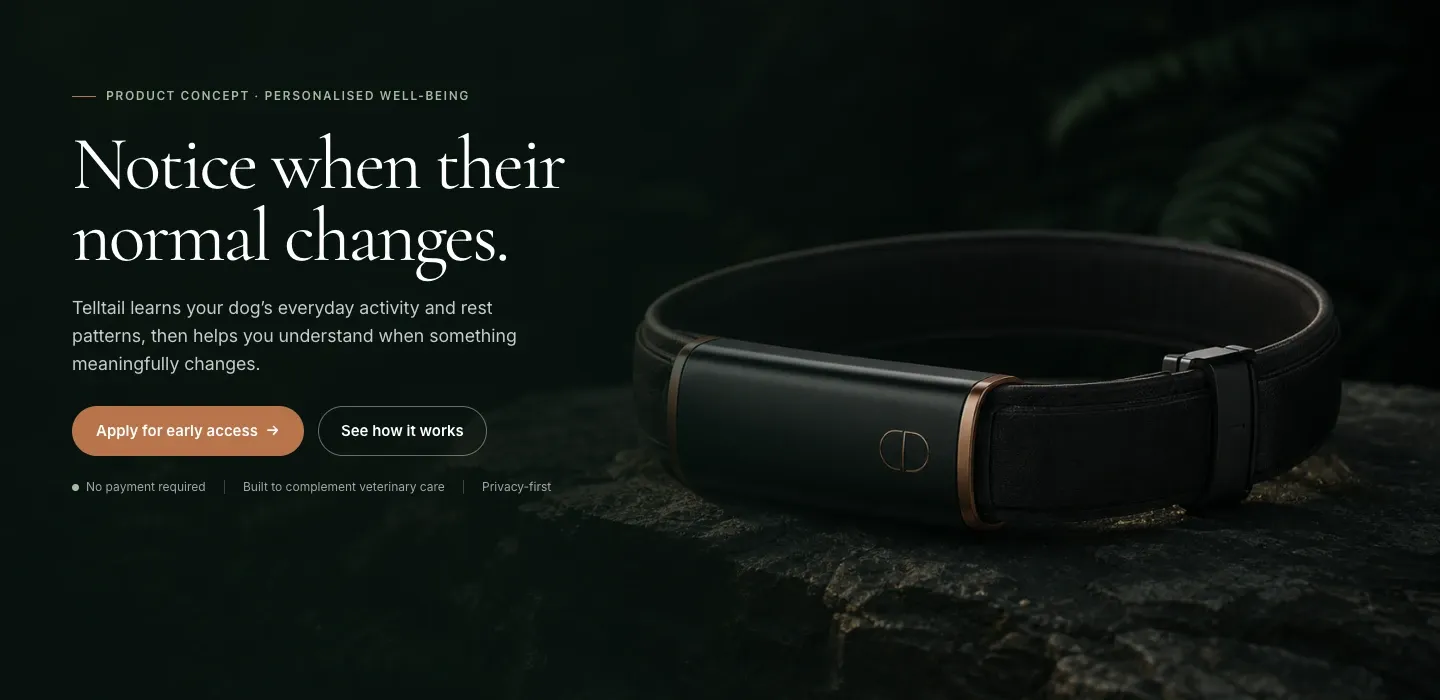
The product visual on this page is a concept from the current TellTail design work, not a shipping device. It exists to test comprehension, value, and trust before real product capability is implied.
The smallest complete learning loop
I am defining the MVP as the smallest trustworthy journey from data to insight to action to feedback—not the smallest version of a collar.
The work is designed to progress through three increasingly real stages:
- A clickable concept prototype with clearly labelled sample data, used to test whether owners understand the insight and intended action.
- A small concierge pilot using owner observations and compatible or research-device data where appropriate, with human-reviewed summaries and explicit limitations.
- A narrow MVP with one reliable data source, an individual baseline, one or two interpretable change types, owner annotation, a safe next action, and a shareable history.
This sequence makes it possible to learn where the value sits before committing to expensive hardware, production, certification, fulfilment, and support.
Trust is part of the product
TellTail sits close to health, emotion, privacy, and animal welfare. Those are not compliance tasks to add after the interface is designed; they shape what the product is allowed to become.
Every proposed insight follows a deliberate claim ladder: measurement, sustained pattern, possible association, conservative guidance, and appropriate escalation. Diagnosis or treatment does not enter the product simply because a model can generate convincing language. Confidence, data quality, limitations, and the distinction between informational, monitor, and seek-care states need to be visible when they matter.
The experience should reduce uncertainty without creating hypervigilance. It must complement veterinary care rather than compete with it, give owners a way to correct known context, and test anxiety and false reassurance as seriously as engagement.
Privacy follows the same principle of restraint. Location, routines, carers, and health-adjacent information can reveal a great deal about a household. TellTail should collect only what it needs, explain why it is needed, make sharing revocable, and support export and deletion.
Earning the right to build hardware
The technical plan starts by separating capture, transport, data quality, individual baselines, interpretation, experience, and learning. Each layer has to justify the next.
The make-or-buy sequence is deliberately conservative:
- Simulate realistic data to test the experience.
- Integrate available datasets, compatible devices, exports, or research hardware.
- Prototype hardware only when the required signal and form factor are understood.
- Consider production design only when demand, usefulness, welfare, and economics support it.
Animal comfort, fit, heat, durability, charging behaviour, and abandonment are product-quality measures alongside sensor accuracy. Custom hardware is earned only if existing options cannot meet a documented need.
Validating the company as well as the concept
The first validation cycle tests the venture from several directions at once: owner behaviour, veterinary usefulness, scientific evidence, technical feasibility, willingness to pay, delivery risk, and unit economics.
The plan begins with conversations about recent, real experiences—not reactions to a polished pitch. It then compares existing devices and data paths, maps evidence for candidate measurements, and tests low-fidelity concepts. Only after a repeated problem appears does the work move toward an instrumented landing page, higher-intent commitment tests, and a small pilot.
At each gate, the decision can be to continue, narrow, revise, pause, or stop. A well-supported stop would be a better outcome than manufacturing an appealing product that creates anxiety, produces unreliable insight, or cannot sustain the service it promises.
Building in public, without manufacturing certainty
I want to document TellTail through seven chapters: validating the vision, proving the market, crafting the core, moving from prototype to pre-orders, preparing for production, igniting the brand, and launching.
The chapters are evidence gates rather than a theatrical countdown. Each update should explain the question, what was tested, what the evidence changed, and what remains unknown. Content can help attract research participants and expert challenge, but it cannot turn a hypothesis into a fact or lock the product into the wrong direction.
That makes the story more interesting to me. The project is not just about whether TellTail works; it is about showing what responsible zero-to-one product development looks like when the subject matters deeply to people.
What TellTail is teaching me
There is a particular kind of discipline in resisting the most exciting version of an idea until it has earned the right to exist.
TellTail asks me to treat changed assumptions as progress, make limitations part of the experience, and design the research system with as much care as the future product. It also makes founder sustainability an explicit constraint. A venture intended to support well-being should not depend on an unhealthy pace to reach the market.
The work so far is foundational: a product thesis, customer and stakeholder hypotheses, evidence and safety rules, a technical feasibility path, a risk register, and a gated roadmap from first interviews to a controlled launch. The next useful result is learning—not a premature feature list.
The broader ambition
If the evidence supports it, TellTail could become a trusted layer between everyday observation and professional care: helping owners understand what is normal for their animal, notice meaningful change, and arrive at better care conversations with a clearer history.
Activity, rest, routine, compatible wearables, veterinary records, and genomics may all have a place over time. None earns a place through novelty alone. Each must improve a real decision, work reliably for the animal in front of it, and meet the same standard of calm, explainable, evidence-led care.
The north star is intentionally human: more good time with the pets we love. The work now is to discover what TellTail can honestly do to help.