The outcome, honestly
Communiti Labs did not become the sustainable company we set out to build. It also did real and consequential work.
Across three years, our team moved from research interviews and rough sketches to products that helped engagement practitioners bring fragmented community feedback into one evidence trail. In 2025 alone, Communiti Analysis processed more than 2.5 million contributions and returned thousands of hours to the people responsible for understanding them.
Those truths belong together. Product impact is not the same thing as commercial sustainability, and a meaningful mission does not remove the need for a repeatable path to market. This is the story of what we built, how it evolved, what worked, and what I would do differently.
The question that started it
Steven Germain and I began with a broad question: how might we help Victorians better engage with community and natural spaces? We did not begin with a predetermined product.
We cold-called and emailed around 100 practitioners and asked what they loved about their work and what stopped them from doing it well. Across those conversations we identified roughly 13 recurring challenges. One thread connected almost everyone: they had too much data and not enough time, resources, or specialised skills to bring it together meaningfully.
These were people people. They cared about advocating for communities, building relationships, and helping organisations make better decisions. But the better they engaged, the more work they created for themselves across workshops, surveys, handwritten notes, spreadsheets, submissions, recordings, interviews, and reports.
Our ambition became simple to say and difficult to deliver: help ensure that no community voice was lost.
The original Communiti Labs identity.
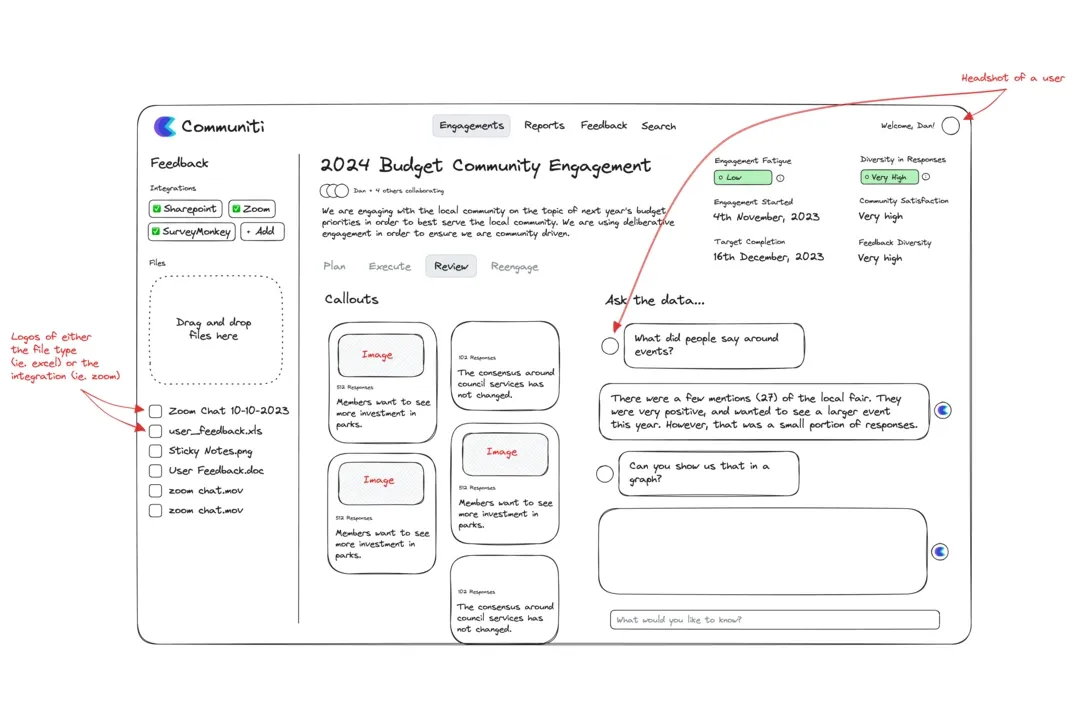
An early 2023 wireframe exploring how fragmented feedback might come together.
MILESTONES / 2023—2026
- 2023
- Listen before buildingAround 100 practitioner interviews surfaced 13 recurring challenges and a shared problem: too much fragmented feedback, with too little time to bring it together.
- 2024
- Co-design the first productTwelve months working alongside practitioners turned a hand-drawn idea into the first public version of Communiti Analysis.
- 2025
- Take Analysis to marketThe team launched a shared analysis workspace, supported real engagement projects, and kept shipping in response to customer feedback.
- 2026
- Broaden the thesis, then stopEarly Conversations pilots explored the complete engagement cycle before Communiti Labs began winding down.
Turning research into product rules
We began with Communiti Analysis and spent 2024 co-designing it with practitioners and organisations across 13 local-government areas and councils. That was separate from the 13 recurring challenges identified during discovery: one number described the research themes; the other described the breadth of people and places involved in shaping the product.
The work established a set of non-negotiable product rules:
- Accept the messy formats engagement actually produces.
- Preserve the original evidence behind every conclusion.
- Keep practitioners in control of interpretation and review.
- Make the final reasoning easy to trace, question, and defend.
The first prototype proved the broad workflow. Twelve months of observation and feedback turned it into a shared analysis workspace grounded in how projects were actually run.
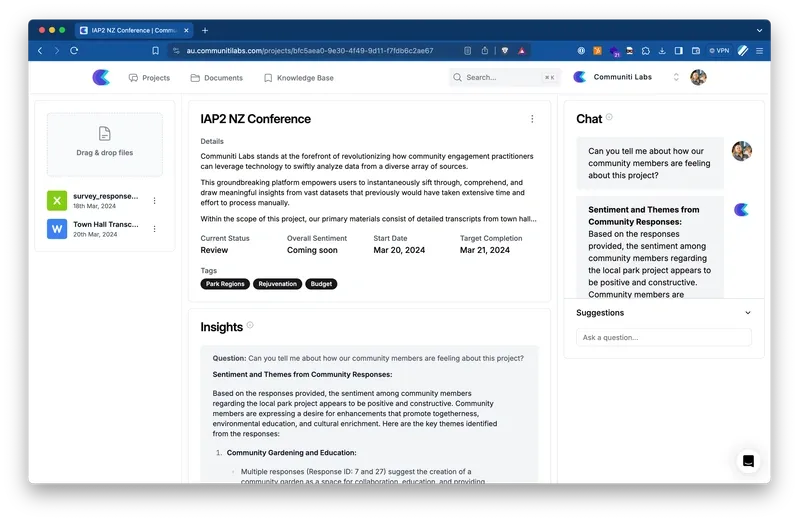
The first version of Communiti Analysis.
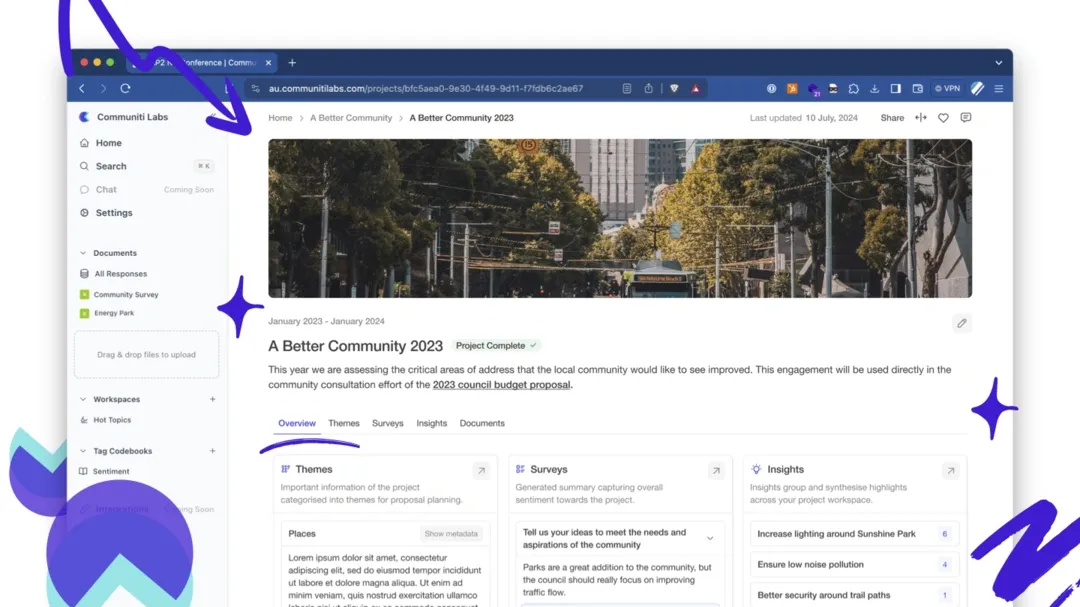
Twelve months of co-design turned the prototype into a shared analysis workspace.
Taking Communiti Analysis to market
The first public version was presented at Engage by the Beach in 2024. In 2025, we took the product to market as Communiti Analysis.
It brought surveys, spreadsheets, documents, written submissions, transcripts, recordings, images, and in-person feedback into one workspace. Teams could identify themes, topics, sentiment, arguments, and supporting evidence without treating every channel as a separate analysis project.
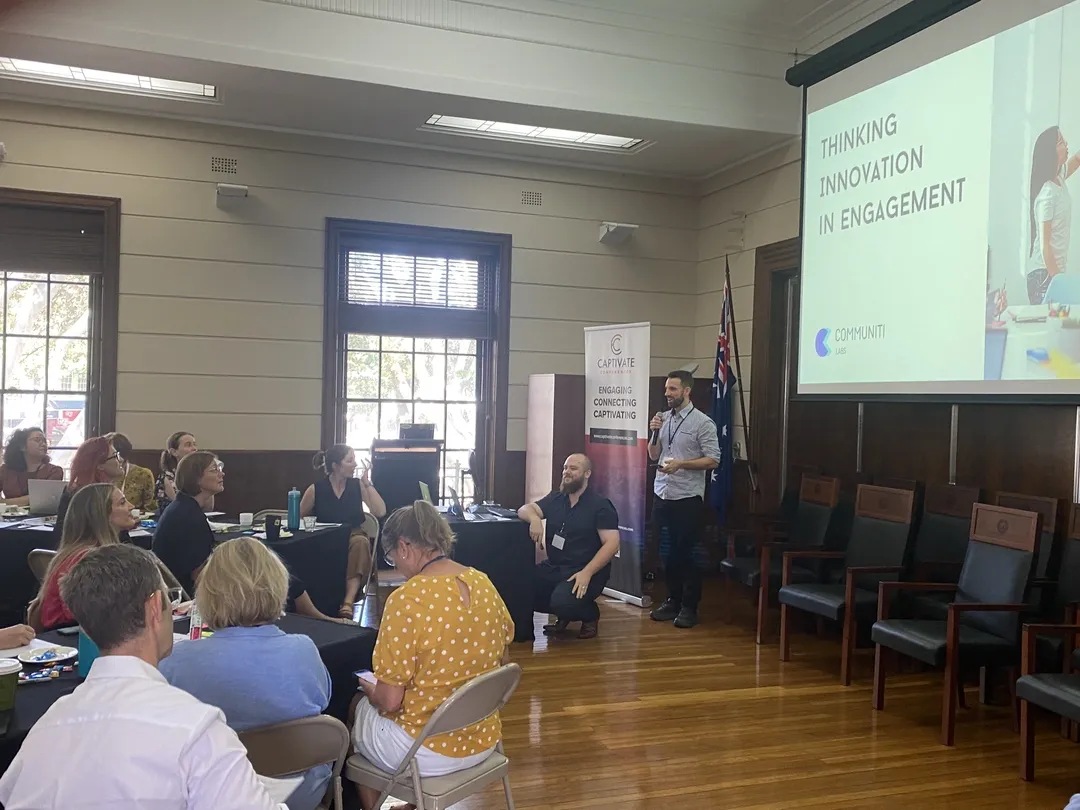
Presenting the first public version of Communiti Analysis at Engage by the Beach in 2024.
Auditability was the product
The aim was never merely to produce a plausible summary or add a chatbot to an existing workflow. Every answer needed to show its working.
Themes, arguments, positions, and reports had to lead reviewers back to the individual, verbatim contributions from which they were derived. The technology was intended to support practitioner judgement, not quietly replace it. That distinction mattered in work shaped by public accountability, conflicting experiences, and decisions with real consequences.
It is never good enough to say, “The platform told me so.”
Building that evidence trail at the convergence of rapidly developing language models, traditional machine learning, and qualitative and quantitative research was one of the hardest technical challenges of my career. It was also one of the most rewarding.
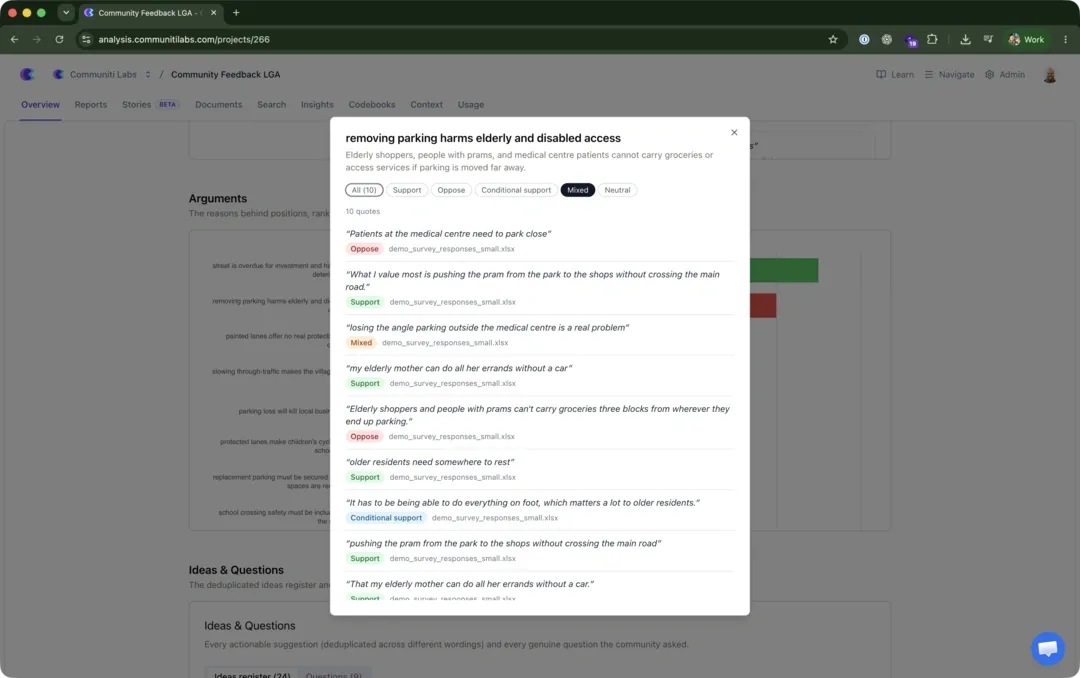
Every conclusion was designed to lead reviewers back to the individual contributions behind it.
What product progress looked like
The numbers below describe product use and estimated customer value. They do not describe a sustainable business, and the distinction matters.
2025 / PRODUCT_IMPACT
- 2,566,343
- Community contributionsProcessed and analysed during 2025.
- 4,867 hours
- Estimated manual work avoidedTime returned to engagement teams for higher-value work.
- 1,171
- Engagement reportsReporting outputs created from connected evidence.
- 32×
- Estimated average ROICalculated from avoided manual-analysis time against platform investment.
- 2,000+
- Platform updatesChanges, features, improvements, fixes, and design overhauls shipped in 2025.
The time-saved and ROI figures were estimates based on the manual coding and synthesis avoided relative to platform investment. They were useful indicators of customer value, not audited financial results.
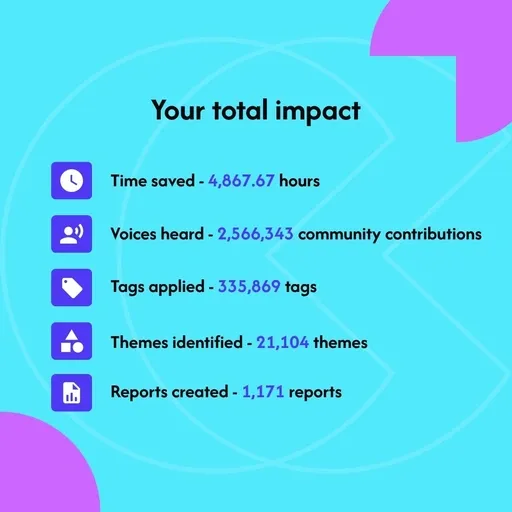
The collective product impact reported across customer work in 2025.
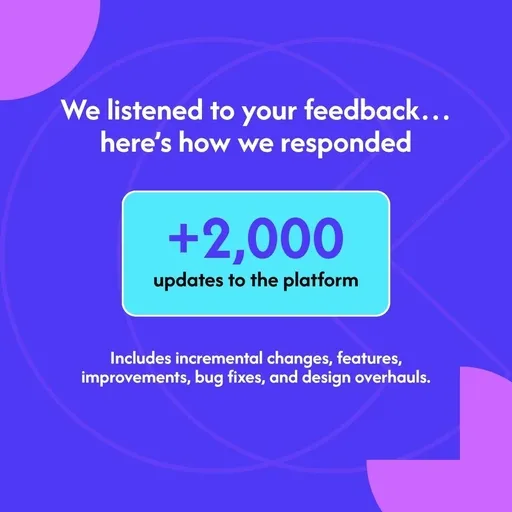
More than 2,000 updates reflected the speed and breadth of the team’s response to feedback.
The practitioner reactions mattered just as much as the totals:
“I can’t believe this took about 20 minutes to produce. It’s exactly how I’d set out my engagement report—but without the hours and hours of manual work.” — Stephanie Roberts, Campbelltown City Council
“What took us three weeks in consulting, Communiti Analysis did in minutes.” — Joyce Jiao, Herekind
Looking beyond the online portal
Our research eventually led to a broader question: what would community engagement look like if technology supported the entire process, not only the survey or the analysis at the end?
That question became Communiti Conversations. We began building an engagement operating system through which teams could plan together, engage across multiple channels, review participation consistently, hand feedback into analysis, and close the loop with their communities.
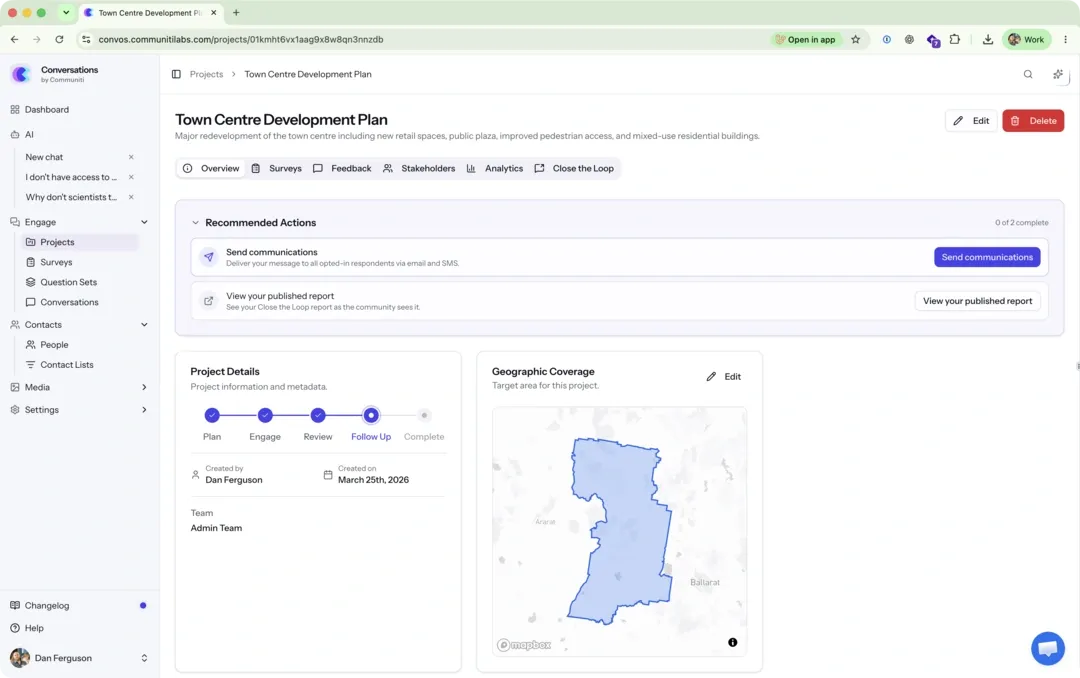
Conversations connected planning, participation, review, and follow-up in one project workspace.
Communities should not have to come to a platform simply because it is convenient for the organisation running the engagement. Participation needed to work across web forms, SMS, email, voice, uploads, in-person activities, and the other channels people already used. Multilingual participation and follow-up also needed to be part of the complete workflow rather than separate, inconsistent tasks.
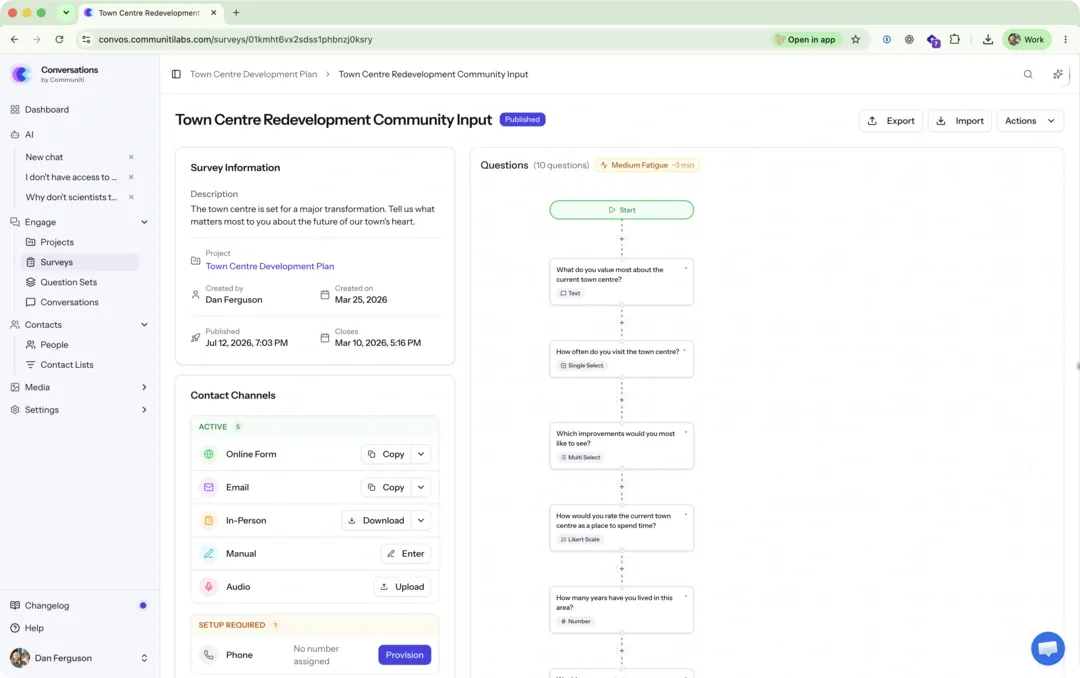
Bring online and offline channels into the same accountable record.
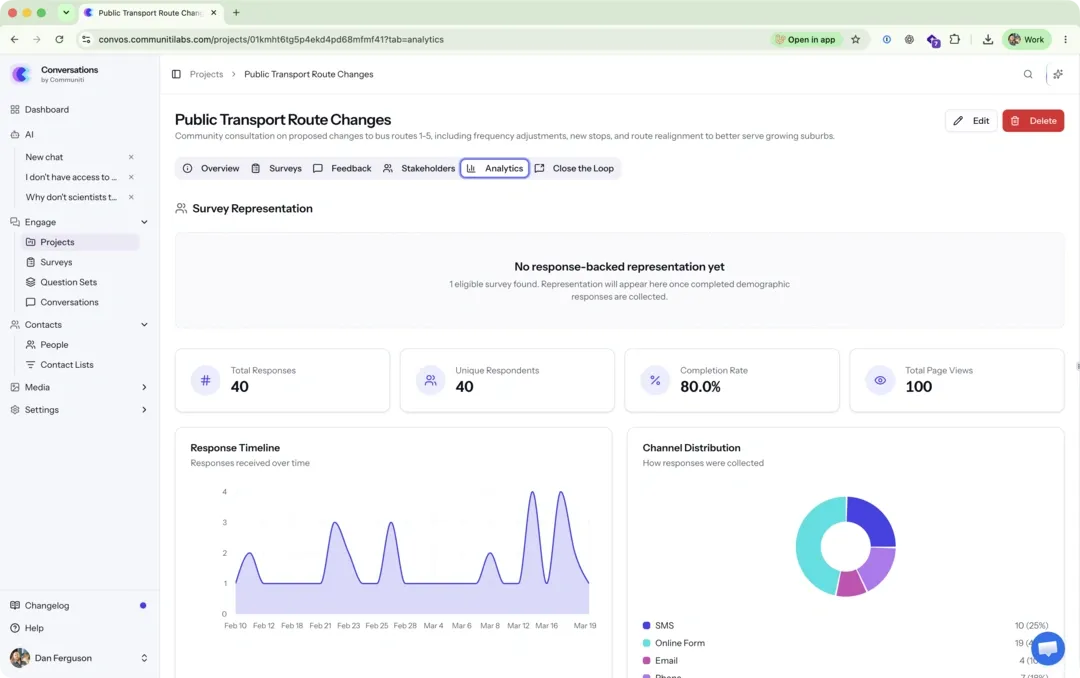
Understand participation consistently across every appropriate channel.
We did not have enough time to give Conversations the future it deserved. Its first pilots nevertheless strengthened my belief that the underlying thesis was right: public participation needs connected systems for planning, participation, analysis, decision-making, and accountability—not simply another online portal.
What did not work
Meaningful product outcomes did not become a repeatable and sustainable path to market quickly enough. Enthusiasm for the mission was real, but enthusiasm and the organisational conditions required to purchase, adopt, and champion a new category of technology were not the same thing.
We could have narrowed our focus sooner. I could have validated willingness and capacity to buy more rigorously, treated procurement and change management as part of the product problem, and built a more disciplined go-to-market motion before broadening the platform vision.
Health and personal capacity also shaped the decision to wind down. A company cannot sustainably pursue its mission when continuing requires more from its people than they can responsibly keep giving. As co-founder and CEO, the responsibility for recognising and responding to those realities was ultimately mine.
Failure to create a sustainable company does not erase what the team built or the value customers received. It does change how I understand the work: a strong product, a necessary mission, and impressive use are all meaningful, but none is a substitute for a durable business model.
What remains
Communiti Labs existed because Steven, Finn, Jarryd, Laura, Becky, our customers, pilot partners, investors, advisers, and many generous practitioners chose to give an ambitious idea their time, trust, criticism, and care. The quality of their work should never be confused with the outcome of the company.
The mission remains important. Community voices still deserve to be heard, understood, and reflected in the decisions that shape people’s lives. The products and technology may yet continue in another form, but their future was not settled when we announced the wind-down.
The full personal account—including the people who made the journey possible and the circumstances behind the decision—is in Closing a chapter: Thank you from Communiti Labs.